Showing posts with label Oriental Culture. Show all posts

Wednesday, June 17, 2009

Gaajan/Charak photos on Photojournale

I haven't been out on the streets with my camera for some days now. Sort of a sabbatical from photography; well if clicking the shutter is all that is about photography. However I worked on my photographs that I took during Bengali New Year celebration and published them on Photojournale:
"Rituals to celebrate Bengali New Year are many. Rural agrarian Bengal used to welcome the new year with the festival of Gaajan/Charak. It is a month long celebration that spans through the last month of Bengali calendar, Chaitra."
More text and photos at Photojournale : Photo journal stories and photo documentary from around the world

I am also putting some efforts recently to roll my new blog with Wordpress: Babbles of a deranged mind. This is in most part a text-only blog and in no way related to my photo-projects. I wish to let loose my ideas and opinions about the world around me through words in this place. I would really like to see you all in my new blog and hope you will find it interesting as much as this one.

Thanks for viewing!!


Full story...

Thursday, April 9, 2009

Summer is approaching...

This is the last month of Bengali calendar, Chaitra. We are at the threshold of the summer season. Well the truth is we are already into it. Report shows persistent temperature rise in the country, and as a result we are having short lived winter, prolong and tiring summer and untimely rain and storms. Not long back there used to be occasional thunder storm and cyclone during this time bringing relief from heat and humidity; even I have seen it in my childhood days. We call this climatic phenomenon Kaalboishakhi. But from the past few years it has become a rare event. So now we are enduring a long and sticky summer season.

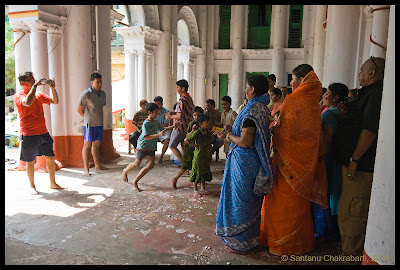
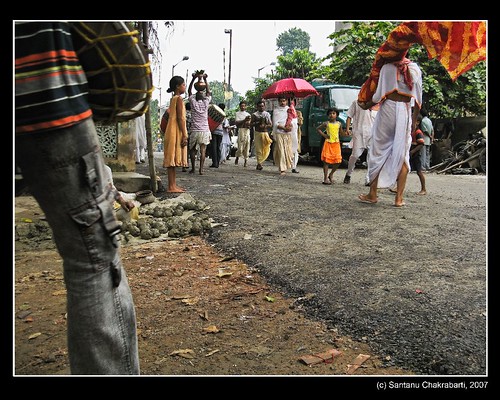
Like changes in climatic condition there are changes in cultural horizon also. Chaitra is the witness to a month long observation of some rituals, that in many cases spills over to the first month of the new year Baishakh. We call it Gaajan and mostly the people from lower rung of the society are the participants. This is a folk religious celebration where an aboriginal god is the central deity whose priest is also a member of the participating community though now a days the festival has been related to the Hindu god Shiva and a Brahmin is seen to take up the role of the priest. Likewise the festival has lost its splendor and ferocity of celebration in Kolkata and its suburbs. The original spirit can now only be found within some interior pockets of rural Bengal.

Social scientists and cultural historians have shown the celebration to be a fertility ritual for an agricultural community where people pray for good rain and fertility of their land in the wake of a dry summer season. It has been shown to be a celebration of marriage between the Sun God and the Earth. The Hindi speaking people from Bihar also worship the Sun God during Chaitra which they call "Chaiti Chhat". The purpose seems to be the same, that is to pray for fertility and good harvest.


Full story...

Saturday, October 11, 2008

Shuva Vijaya Dashami

In English the title may be stated as "The blessed tenth day of victory" (though I am not a great translator). This is the day when, it is believed that, Lord Rama got victory over Ravana thus marking the victory of good over evil. Last Thursday was the day for this year.

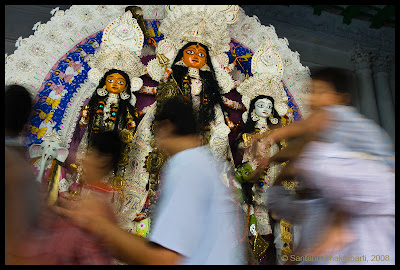
On this day the four days long Durga puja festival in Bengal also comes to its end. Durga puja is the biggest get together event for Bengalees around the globe. Now is the time to bid adieu to our friends and relatives to get back to our work again.

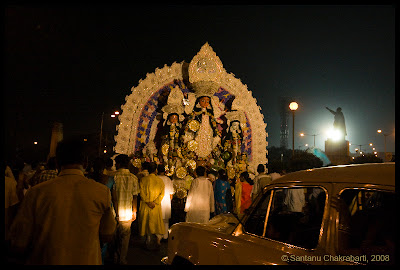
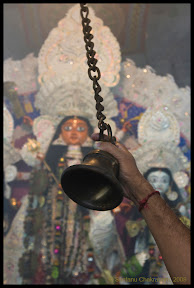
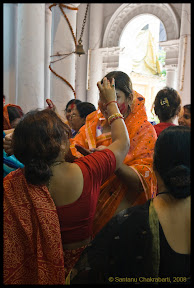
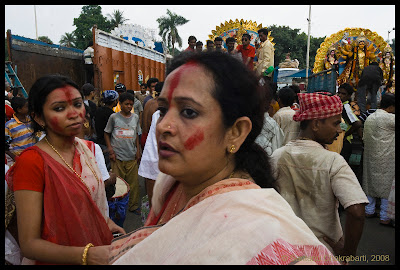
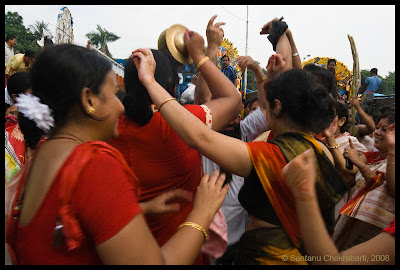
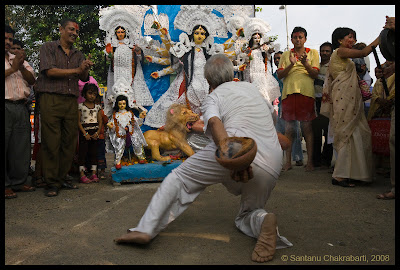
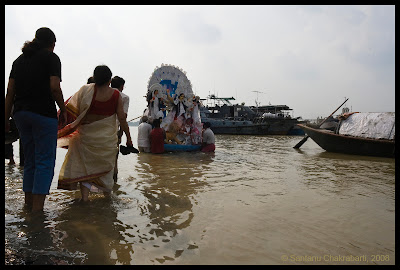
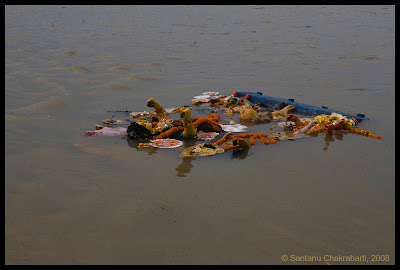
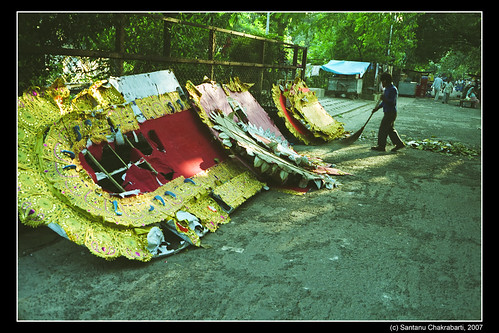
The idol is taken to the river Ganga (or any near by river) for immersion. Some rituals are observed before immersion, like the ritual of vermillion (sindoor/bindi), farewell ritual using a mirror, greeting the idol with sweets before leaving for immersion, etc. On the bank of the river members of the family (girls and boys alike) perform free-style dance before the idol to greet the Goddess before bidding farewell for the year. Huge number of pople flock to the bank of the river to watch the ceremony and the balloon vendors, the candy sellers and other hawking people take this opportunity to make a few bucks on this festive season. But these days they are not alone; big names also arrange ad-campaigns at these sites to spread brand awareness.


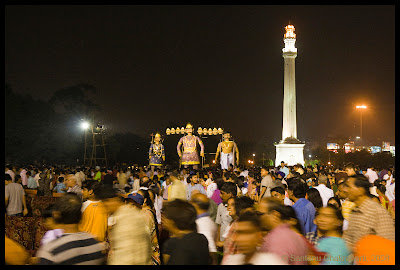
In Kolkata one may also watch enactment of the battle between Lord Rama and Ravana (Ramlila); this year it took place in the ground near "Shahid Minaar". The show was arranged by "Punjabee Bradree" in presence of some ministers of the state and other dignitaries. At the end of the show it is customary to burn effigies of Ravana and his brothers by throwing fire crackers at them. This year, though fire crackers were thrown at them, the effigies could not be set on fire as they had already been soaked in water by city administrators in fear of a possible accident.

To see more photographs please check my Picasa web album.

Full story...

Wednesday, June 11, 2008

Bauls: The folk singers of Bengal


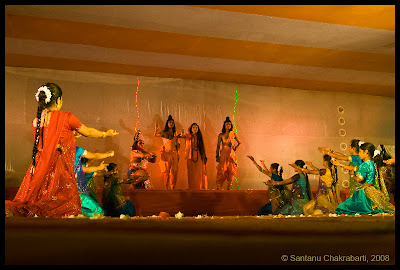
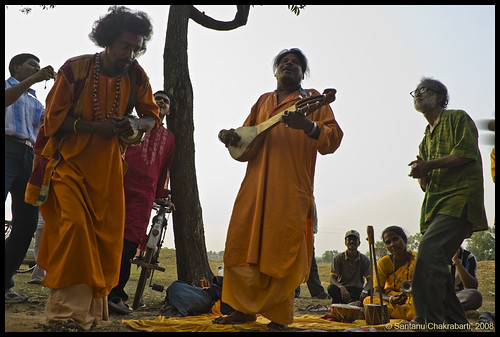
Bauls are folk singers of Bengal. They are mostly found in the Birbhum district of the state. The subject of a Baul song can be anything from daily tidbits to very complex spiritual theories. Baul songs are not only to be sung but also be accompanied by dance performances by the Bauls themselves. There is no rule for the dance movements; they are spontaneous body movements in response to the rythm of the song. Melodious nature and beautiful rythm of the Baul songs even make the audiences tap their toes.
Full story...
Sunday, March 30, 2008

Holi - The Color Festival

The Friday before the last one was very special, it saw religious celebrations by the three major religious groups - the Hindus, the Muslims and the Christians in India. The Hindus had Holi, the color festival, the Muslims commemorated the birth of the Prophet and the Christians observed Good Friday.

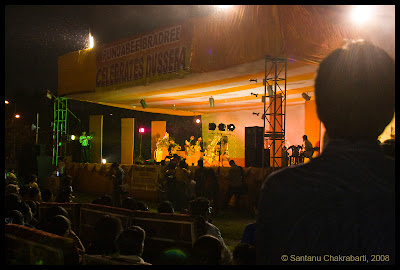
On that day I visited Santiniketan with my friends, which is one of the cultural hubs of Bengal. It was conceptualized by the great poet Rabindranath Tagore. Holi at Santiniketan has a special aura of cultural sophistication around it which people flock there to enjoy. However, change is the only constant in human life, so these days you can also find some not so well known rock-bands performing there. I tried to capture these moments while taking photos there.


Full story...
Tuesday, December 11, 2007

Navapatrika - The Deity of Nine Plants

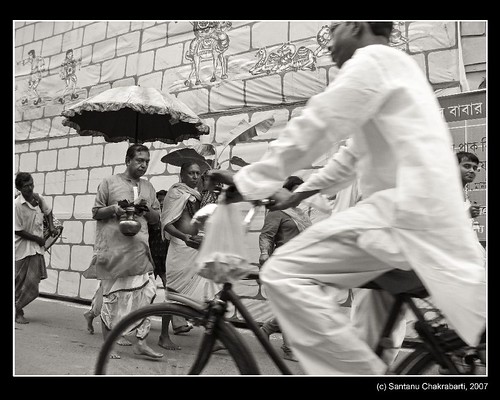
The festival of Durga puja takes up its momentum by observing ceremonial bathing of Navapatrika, a form made up of nine plants wrapped up in a piece of cloth, on the second day - that is "Maha Saptami". "Nava" means nine and "Patrika" means plants in Sanskrit. The nine plants are - Banana (Kadoli), Wood apple (Vilva), Pomegranate (Dadim), Turmeric (Haridra), Barley (Jayanti), Asoka, Paddy (Dhanya) and Kachu (Arum colocasia). The nine goddesses presiding over the individual plants are Brahmani, Kalika, Durga, Karttiki, Siva, Raktadantika, Sokarahita, Camunda, and Lakshmi respectively. These are the nine manifestations of the "Parama Prakriti" (The Absolute Nature), that is the goddess Durga. Hence in essence it is a form of worshiping the Mother Earth.


In popular belief the deity is imagined as the spouse of Ganesha, hence the name "Kolabou" or "The Banana wife". The main frame of the form is made up of a leafy banana trunk and thus it is called "Banana wife". I think there is a meaning to this association. The other name of the Lord Ganesha is "Siddhidwata", meaning the giver of success and prosperity. In an agricultural society what can be more prosperous than fields full of crops, trees heavy with fruits and lush green vegetation?


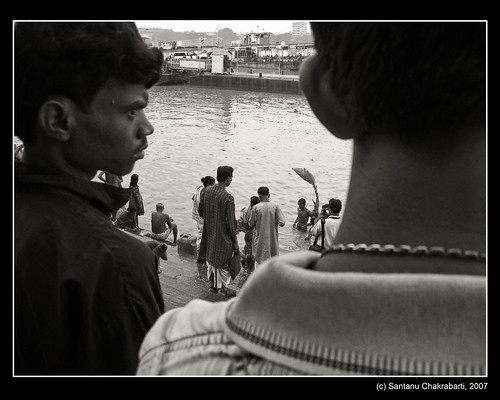
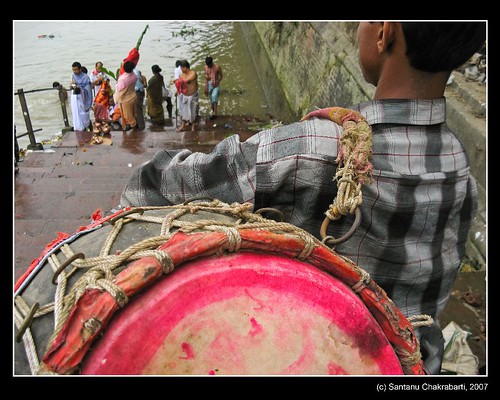
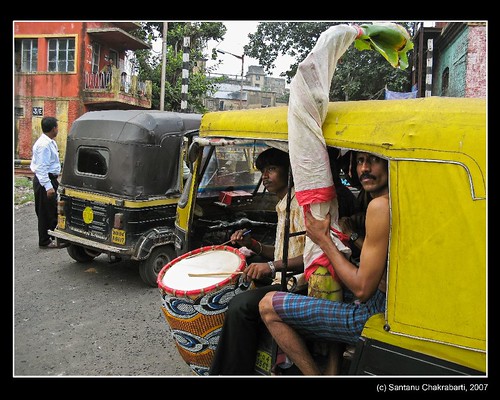
Early in the morning the deity is taken to the bank of a river for the ceremony, among beating of the drums. In Kolkata it takes place mainly at the ghat of the river Ganga. At the start of the ritual the plants are immersed in the water of the river for washing. Then it is wrapped up in a new piece of cloth and the puja starts with the chanting of the mantras. The deity is offered fruits and sweets for Her pleasure. After all the rituals of puja are over the deity is taken back to the pandal and is placed by the side of the Ganesha.

Resources:

http://www.belurmath.org/durga_puja/article_on_durga_puja.htm

http://www.happy-nomads.nl/phulpati-dashain-nepal.html

http://www.hscnet.org/hwp.php?articleid=7


Full story...
Sunday, November 25, 2007

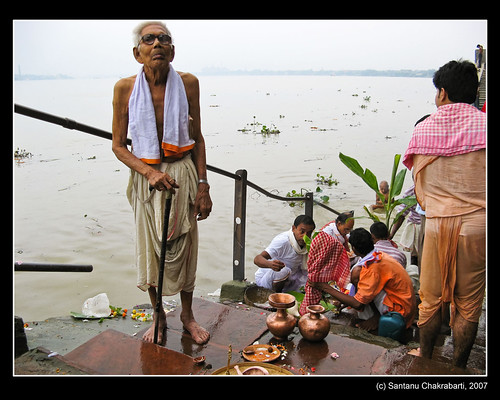
The elderly priest of Durga puja

I met this aged person at Kumortuli ghat during Kolabou puja. He is the eldest priest of Durga puja, at least in Kolkata I think. What I made out from what he said in his soft voice amidst the beating of the drums is that he is around 92-93 years old. But still he is actively involved in Durga puja as a priest observing all the rituals with utmost earnestness. Actually he was supervising the ceremonial bathing of Kolabou while I took this photo. He told me his name, but I missed it in the noise of the beating drums and I didn't like to disturb him. He was once featured in a popular local newspaper here while going to Bangkok for the purpose of Durga puja in the year 2001.

I searched the archive of the newspaper in the net, but couldn't find anything. I am trying to know more about this person of great stamina. If someone visiting this blog happens to recognize him please leave me a comment.

More about ceremonial bathing of Kolabou or Navapatrika will be coming shortly.

Durga puja, Kolkata, 2007

Full story...

Friday, November 23, 2007

The End of the Show!!

So the festive season has ended at last!!
It all started with Durga puja, or rather with Eid this year. These two festivals always come side by side, separated just by few days. The end comes with the immersion of the idol of Goddess Kali. For Hindi speaking people it is the Chatpuja and it has been held the last saturday.

So its the end of the show. Or is it? I think the autumn festivals are just the beginning of a six months long festive season which ends up with the Saraswati puja, the goddess of learning. Then again the summer starts, the season of sweating and suffocation. Now the weather is pleasant in this part of the world, and so many festivals and ceremonies are in the line.

Lots of activities on the streets of Kolkata, means lots of opportunities for beautiful photographs. I have already shot photos on the occasion of Durga puja, Kali puja and Chatpuja. Shall publish them here shortly, so stay tuned.

Enjoy the festive season!!

Full story...