Saturday, February 16, 2008

Science Express: An Indo-German collaboration in community education

Science Express is a symbol of Indo-German cooperation in Science and Technology. “It invites you along on a fascinating expedition into the mysteries of our world – to groundbreaking discoveries, emerging issues of cutting-edge science and future oriented technologies.” It is a multimedia and hands-on exhibition developed by Max Planck Society, Germany. Installed in thirteen carriages of a special train, it will be visiting 56 towns, including many isolated places. It is hoped that it will fire the enthusiasm of young people in India for science, and will be encouraging Indian experts to undertake courses of study in Germany.

Acknowledgement:

Thanks to Mr. Bhaskar B. Shukla (Administrative Officer) and other members of Vikram A Sarabhai Community Science Centre.


Please browse to the following link to see the slide-show of my photos.

http://www.lightstalkers.org/galleries/slideshow/10238


Full story...

Wednesday, January 30, 2008

The Street Circus


The winter season in Kolkata is the season for merriment. Lots of picnic, sports and other events are arranged. People go out in the afternoon sun to enjoy its warmth.

This is the time when street-performers come out in the street to show there feats. Mostly the gypsies or the poor people from nearby Kolkata flock at the different corners of the central Kolkata to perform rope walking, fire eating and many other juggling games.

In the photo above I have captured one little gypsy girl performing rope walking with pitchers on her head at New Market area, while in the second photo, at the same area, a Japanese tourist is performing fire dance with two fire balls.

Full story...

Sunday, January 27, 2008

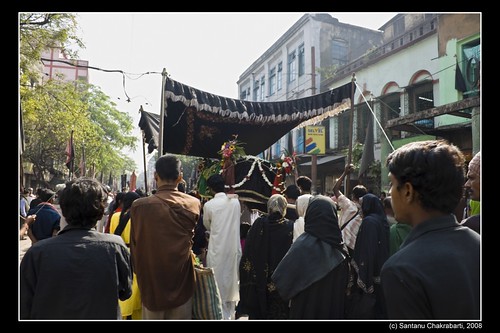
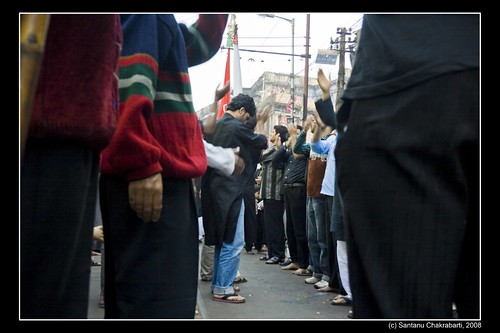
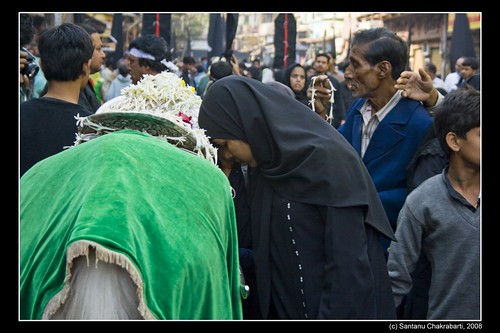
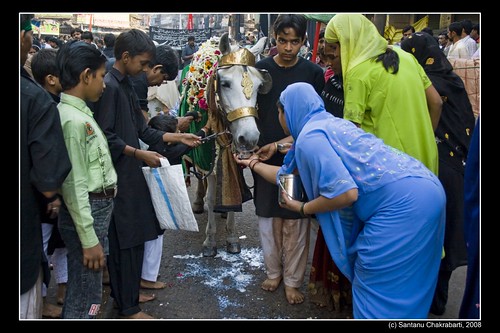
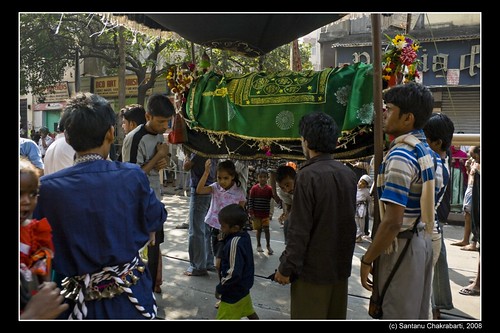
Muharram in Kolkata

Its long since I haven't been around. Mostly due to some network failure at the beginning, but then I got busy with shooting the events that were coming up. After the autumn festival the two months of winter season, that is December and January, are most eventful. I wish to share my photographs on Muharram here. Others are following by soon.


Muharram is the first month of Islamic lunar calendar, Hijrah. It is one of the four months that have been designated as Holy according to the Islamic belief, the other three being - Dhul-Qa'adah (Zulqa'dah), Dhul-Hijjah (Zulhijjah) and Rajab. However the first ten days of the month are considered as most sacred. Fasting is advocated in the month of Muharram, but the fasting on the tenth day of Muharram, called Ashura, is particularly important, as it is supposed to lead to great rewards.


Muharram is an important month to the people of Islamic faith. Many auspicious events of Quranic history are believed to have taken place during this month, specially during the tenth day. Some of the events are: The Prophet Adam was born and his repentance was accepted on this day, the Prophet Abraham was saved from the Fire, the Prophet Ishmael was delivered from the Sacrifice, the Prophet Joseph was reunited with his father, the Prophet Job was cured of his illness and the Prophet Solomon was ordained as king; however no accurate historical evidences could be found for them.

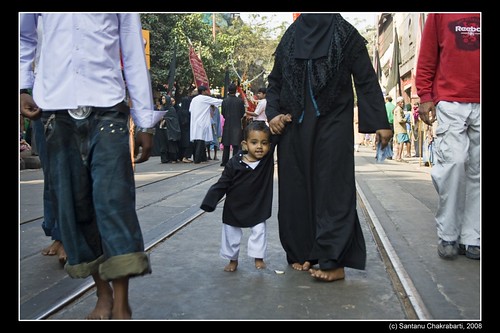
Shiite Muslims observes the first ten days of Muharram to commemorate the martyrdom of Imam Hussain and his family, the grandson of the holy Prophet. Hence Muharram is not a festival in the celebratory sense to the sect as it mourns the Karbala tragedy. Muslims build paper and bamboo replica of the martyr's tomb, called Tajiya or Tazia, and carry them into the street in a procession to mourn Imam Hussain's brutal assassination. Mourners walk barefoot, beat their chests and cry out the name of Imam Hussain. Some plaintive verses are recited to signify that Hussain and his family had to suffer terrible thirst during their murder. The youths whip them with chains or hit them with knives to draw blood out of their body to symbolize the physical pangs that Imam Hussain had to suffer. Horses decorated as a battle horse with swords, etc. are also taken out in the procession in memory of Hussain's horse, Duldul.


Sunni Muslims also commemorate Imam Hussain's martyrdom but in a less demonstrative manner, concentrating instead on its spiritual aspect.

The word Muharram is derived from the word Haram, which actually means forbidden; it also means respect. Hence the month of Muharram encourages people to forbid themselves from all worldly pleasures and to respect the great children of the Mother Earth by commemorating their sacrifices towards the establishment of Truth and Justice.

More photos in my Flickr.


Resources
=========

1. http://www.jannah.org/articles/muharram.html

2. http://www.indiawijzer.nl/tourism_travelling_to_india/fairs_and_festivals/march/muharram.htm

3. http://www.alinaam.org.za/library/imuharram.htm

4. http://www.indiaparenting.com/indianculture/festivals/fest009.shtml

5. http://muslims-r-us.blogspot.com/2008/01/what-really-happened-on-10th-muharram.html

Full story...

Wednesday, December 12, 2007

The Balloon Vendor

Balloons have recently been turned into a means to express euphoria, mainly the elongated rod-shaped ones. Hence in many a occassion, like the immersion of a deity or the celebration of victory by a favourite team, their use is abundant. You can wrap them round your forehead or hold two of them tightly against wind to make sound or just can swing them to show your enjoyment.

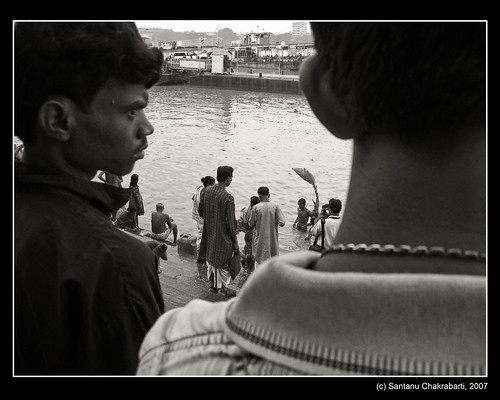
This shot was taken at an immersion ghat on the bank of the river Ganga. This balloon vendor was waiting at the doorway of the ghat for his clients, the gangs coming to the ghat for immersion of the goddess Kali.

Judge's ghat, Kolkata. Nov. 2007

Full story...

Tuesday, December 11, 2007

Navapatrika - The Deity of Nine Plants

The festival of Durga puja takes up its momentum by observing ceremonial bathing of Navapatrika, a form made up of nine plants wrapped up in a piece of cloth, on the second day - that is "Maha Saptami". "Nava" means nine and "Patrika" means plants in Sanskrit. The nine plants are - Banana (Kadoli), Wood apple (Vilva), Pomegranate (Dadim), Turmeric (Haridra), Barley (Jayanti), Asoka, Paddy (Dhanya) and Kachu (Arum colocasia). The nine goddesses presiding over the individual plants are Brahmani, Kalika, Durga, Karttiki, Siva, Raktadantika, Sokarahita, Camunda, and Lakshmi respectively. These are the nine manifestations of the "Parama Prakriti" (The Absolute Nature), that is the goddess Durga. Hence in essence it is a form of worshiping the Mother Earth.


In popular belief the deity is imagined as the spouse of Ganesha, hence the name "Kolabou" or "The Banana wife". The main frame of the form is made up of a leafy banana trunk and thus it is called "Banana wife". I think there is a meaning to this association. The other name of the Lord Ganesha is "Siddhidwata", meaning the giver of success and prosperity. In an agricultural society what can be more prosperous than fields full of crops, trees heavy with fruits and lush green vegetation?


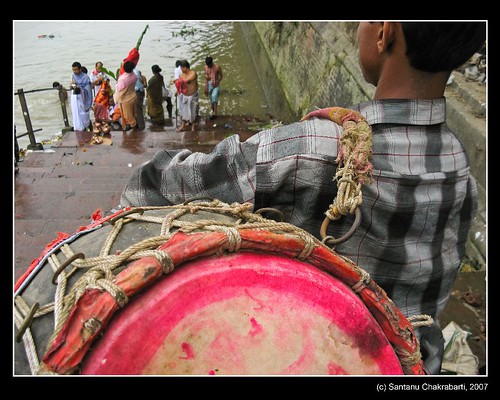
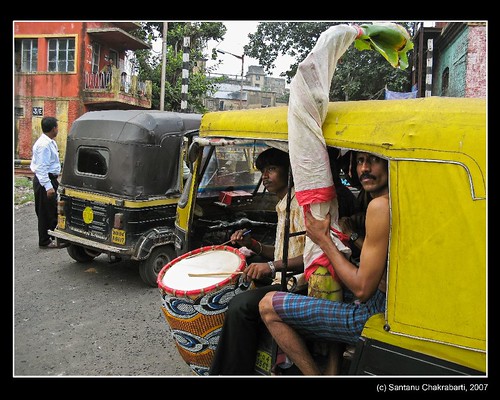
Early in the morning the deity is taken to the bank of a river for the ceremony, among beating of the drums. In Kolkata it takes place mainly at the ghat of the river Ganga. At the start of the ritual the plants are immersed in the water of the river for washing. Then it is wrapped up in a new piece of cloth and the puja starts with the chanting of the mantras. The deity is offered fruits and sweets for Her pleasure. After all the rituals of puja are over the deity is taken back to the pandal and is placed by the side of the Ganesha.

Resources:

http://www.belurmath.org/durga_puja/article_on_durga_puja.htm

http://www.happy-nomads.nl/phulpati-dashain-nepal.html

http://www.hscnet.org/hwp.php?articleid=7


Full story...

Sunday, November 25, 2007

The elderly priest of Durga puja

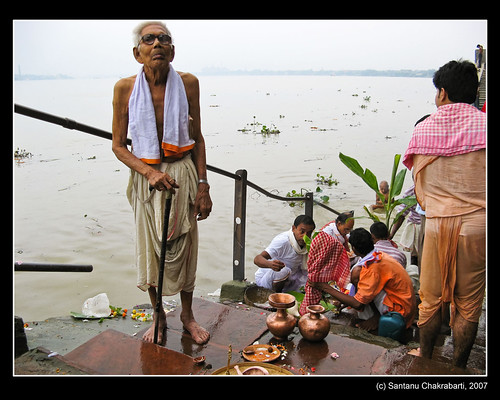
I met this aged person at Kumortuli ghat during Kolabou puja. He is the eldest priest of Durga puja, at least in Kolkata I think. What I made out from what he said in his soft voice amidst the beating of the drums is that he is around 92-93 years old. But still he is actively involved in Durga puja as a priest observing all the rituals with utmost earnestness. Actually he was supervising the ceremonial bathing of Kolabou while I took this photo. He told me his name, but I missed it in the noise of the beating drums and I didn't like to disturb him. He was once featured in a popular local newspaper here while going to Bangkok for the purpose of Durga puja in the year 2001.

I searched the archive of the newspaper in the net, but couldn't find anything. I am trying to know more about this person of great stamina. If someone visiting this blog happens to recognize him please leave me a comment.

More about ceremonial bathing of Kolabou or Navapatrika will be coming shortly.

Durga puja, Kolkata, 2007

Full story...