The morning market at Cheenapara, or the old China town in Central Calcutta, is the nerve centre of social life for the communities living in the neighbourhood. It becomes alive with activities from early in the morning. People flock to the place to collect their daily supply of vegetables, fish and meat. Although it has lost its past glory still a number of food stalls run by the Chinese people can be found here selling Chinese snacks, sweets and other food items.
In the slideshow below I present a glimpse of the daily life in the market premise. I tried to focus on the symbiotic co-existence of the different communities for whom the old China town at Central Kolkata is the home.
Full story...
Sunday, August 17, 2008


Sunday, July 6, 2008
Rathayatra: The chariot festival of India
 One of the important festivals of Monsoon season in India is Rathayatra, the chariot festival. The last Friday, that is 4th July this year, was the day for the festival. Although the rituals are observed for the seven consecutive days the first day celebration is the most cheerful and pompous one.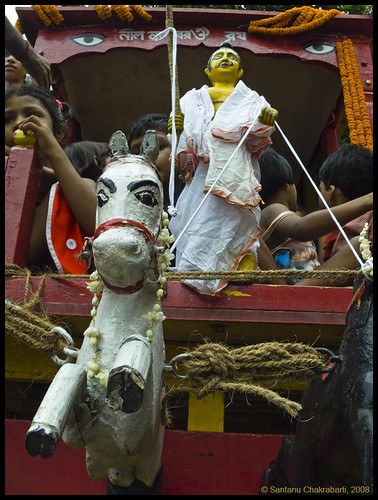
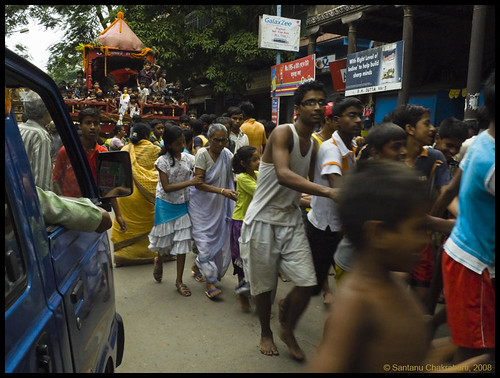
 The original seat of the festival is at Puri in the state of Orissa though these days, due to Indian diaspora, it seems one can witness the festival in the most unexpected location of the world. In India, other than Puri, there are some places which are renowned for the festival. For example in Bengal the chariot festival in Mahesh is considered to second that of Puri in spirituality.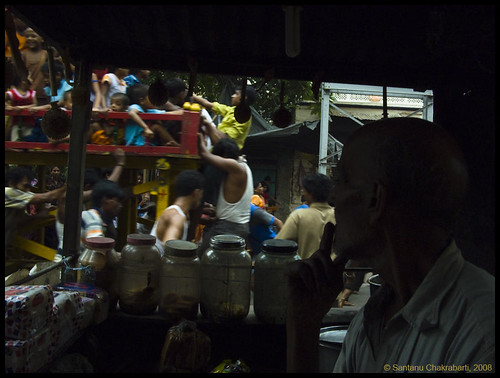
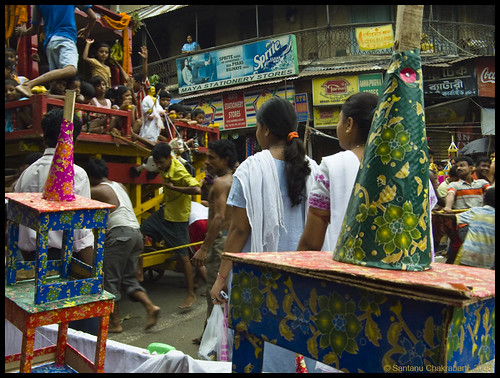
In India to drag the chariot for someone is considered an act of showing the highest honour
 to the person. When Swami Vivekananda returned after propagating the message of Hinduism at the World Parliament of Religion in USA, the students at Kolkata dragged his horse cart to show their heartfelt respect. The main activity in the festival of Rathayatra is also to drag the chariot of the Gods Sri Jagannatha, Sri Balarama and Devi Subhadra by the devotees. Sri Jagannatha is considered to be the God of all gods and the protector of the whole world. It is believed that on this occasion Sri Jagannatha comes down from his divine abode to meet his devotees on the Earth.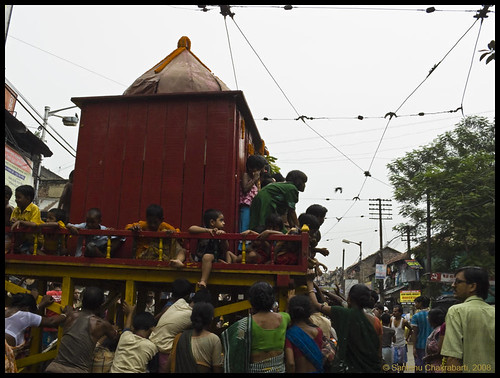

Each neighbourhood in Kolkata has its temple of Sri Jagannatha and the community brings out a chariot which they drag through the streets of the locality. People from the nearby houses come
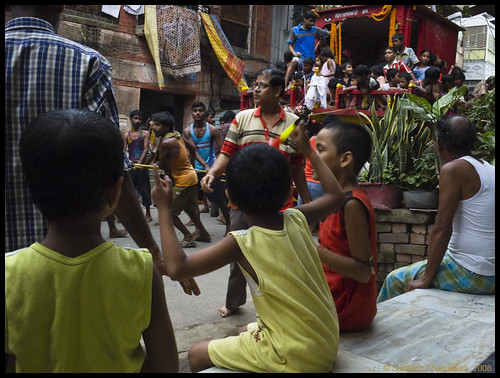 out on the street as the chariot reaches their place to show tribute to the God and to offer sweets and fruits to please Him. Some old families in Kolkata also bring out their family chariots to the street. Recently ISKCON is also celebrating the day in Kolkata and it is one of the most colourful and the biggest events here. However it is the children who seem to enjoy most on this occasion. They buy small wooden chariots from the shops, decorate it with flowers and leaves, place small idols of the gods inside it and then drag it through the streets with blowing of palm leaf horns. At the dusk people get back home buying some bengali snacks like papad, jeelabi, etc.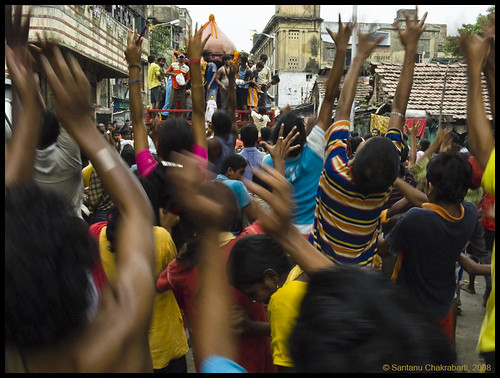
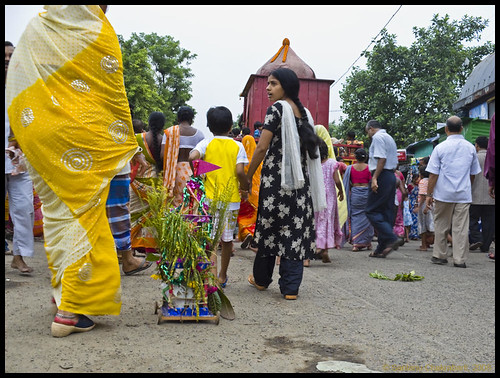
The God is said to be taken to His aunt's house on the chariot as the part of the first day celebration and after the seven days of observing the rituals on the last day the God is again taken back to His place on the same chariot.
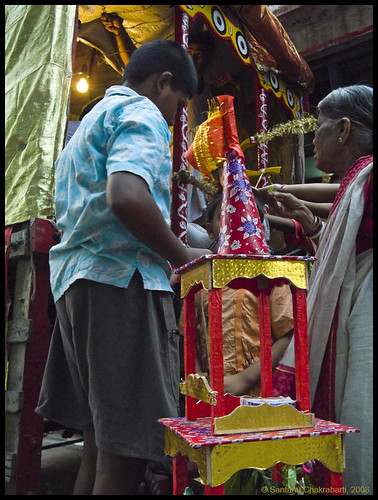
Full story...
Sunday, June 29, 2008
A Summer Afternoon
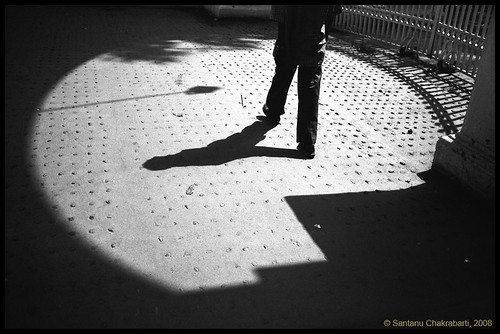 On a summer afternoon the blazing Sun has cast a dark shadow of one of the entrances of Governor's House at Esplanade, Kolkata. We call it "Raj Bhavan". This was the seat of British imperial power during Raj era. Now it serves as the residence of the Governor of the Indian state of West Bengal. For more information please visit:
rajbhavankolkata.gov.in
en.wikipedia.org/wiki/Raj_Bhavan_(West_Bengal)
Full story...
Wednesday, June 11, 2008
Bauls: The folk singers of Bengal
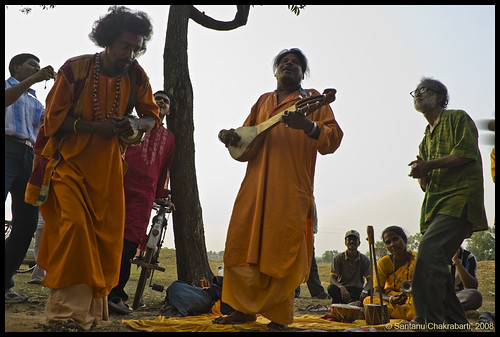
Bauls are folk singers of Bengal. They are mostly found in the Birbhum district of the state. The subject of a Baul song can be anything from daily tidbits to very complex spiritual theories. Baul songs are not only to be sung but also be accompanied by dance performances by the Bauls themselves. There is no rule for the dance movements; they are spontaneous body movements in response to the rythm of the song. Melodious nature and beautiful rythm of the Baul songs even make the audiences tap their toes.
Full story...
Wednesday, June 4, 2008
So I take a leap
 Last Friday was my last day at my current day-job. It was in software engineering and so was high paying. My friends were shocked at my decision. Their concerns were quite logical. These days there are not many job that allow you to live lavishly, and just for a few thousand bucks people toil like anything.
But while my job was allowing me to buy expensive photo-gears, I was not able to buy time to use them. So it turned out either I have to stop thinking about photography or quit this job. I opted for the latter.
So what shall I do next? Try for some work in photography, in whichever area it is. Well this is only a short term solution I think. I look at myself as a photographic content developer, and as such I need to develop an understanding of the market where I shall be playing a role. I need to have a well chalked out career path in that market.
I shall keep sharing with you my friends all my experiences. For the time being I concentrate on finishing off the pending tasks. I just completed working on my photographs I took during Ganga Sagar mela at Maidan, Kolkata. I made a PDF book with them too. My friends have some good words to say about the PDF, but I want to hear it from you.
I present here only the partially completed version of the PDF, as the book is a bit big (6MB only). If you like to get hold of the complete PDF please contact me. Please provide me your full name, email id, profession you are in and a little bit of yourself.
Full story...
Friday, May 2, 2008
Flower Market devastated by fire ...Contd.
On the second day after the fire, that is 13th April 2008.
The administrative body of the market has taken a decision the day before to clear up the debris from the site by the following night. Hence by next morning space has been made for the vendors to start operation as much as possible so that loss is minimum.

 Vendors started business on the cleared up site. The next day, that is 14th April, was the Bengali New Year and hence a boom in sale was expected.
 A boy scavenging in the heap of debris still remaining to be cleared up from the site.
 The camp of the labourers in the market who worked on the previous night to clear up the site from debris. Much were yet to be done.

 Vendors set up temporary shelters with bamboos, the wooden pillers which are not completely burnt and plastic sheets.
 Lots of scrap iron sheets, rods, welded frames , etc. had been produced due to the accident. Scrap metal vendors flocked to the place for their share.

 The fire had taken away all colours from the market and turned it into black ashes. On the second day of the accident the market was struggling desperately to regain its usual colour.
Full story...
The administrative body of the market has taken a decision the day before to clear up the debris from the site by the following night. Hence by next morning space has been made for the vendors to start operation as much as possible so that loss is minimum.

 Vendors started business on the cleared up site. The next day, that is 14th April, was the Bengali New Year and hence a boom in sale was expected.
 A boy scavenging in the heap of debris still remaining to be cleared up from the site.
 The camp of the labourers in the market who worked on the previous night to clear up the site from debris. Much were yet to be done.
 Vendors set up temporary shelters with bamboos, the wooden pillers which are not completely burnt and plastic sheets.
 Lots of scrap iron sheets, rods, welded frames , etc. had been produced due to the accident. Scrap metal vendors flocked to the place for their share.
 The fire had taken away all colours from the market and turned it into black ashes. On the second day of the accident the market was struggling desperately to regain its usual colour.
Full story...
Subscribe to:
Posts (Atom)


