Showing posts with label Culture. Show all posts

Wednesday, June 17, 2009

Gaajan/Charak photos on Photojournale

I haven't been out on the streets with my camera for some days now. Sort of a sabbatical from photography; well if clicking the shutter is all that is about photography. However I worked on my photographs that I took during Bengali New Year celebration and published them on Photojournale:
"Rituals to celebrate Bengali New Year are many. Rural agrarian Bengal used to welcome the new year with the festival of Gaajan/Charak. It is a month long celebration that spans through the last month of Bengali calendar, Chaitra."
More text and photos at Photojournale : Photo journal stories and photo documentary from around the world

I am also putting some efforts recently to roll my new blog with Wordpress: Babbles of a deranged mind. This is in most part a text-only blog and in no way related to my photo-projects. I wish to let loose my ideas and opinions about the world around me through words in this place. I would really like to see you all in my new blog and hope you will find it interesting as much as this one.

Thanks for viewing!!


Full story...

Wednesday, April 29, 2009

Best wishes on World Dance Day

Dance is an integral part of Human existence. Before people learnt to use verbal languages for communication they used systematic movement of body parts as a form of sign language. Even for a successful hunting expedition it was mandatory to perform the ritualistic magic of hunting dance. Today dance is an important component of rehabilitation efforts and therapies organized for the amelioration of emotionally, psychologically or socially challenged people.

To draw the attention of general people towards the contribution of dance to human history and society and to build up awareness about different forms of dances, International Dance Council CID, UNESCO has specified 29th April of every year to celebrate World Dance Day, in the year 1982. All organizations and individuals associated with dance and dancing are requested to organize activities to reach a broader audience than usual.

I have some photographs of dancing from different festivals, ceremonies and rituals that I was fortunate to witness and thought to share them with you on this occasion. So I created the slideshow attached below. I believe the photographs are evidence of pervasiveness of dancing in our society.


Full story...

Thursday, April 9, 2009

Summer is approaching...

This is the last month of Bengali calendar, Chaitra. We are at the threshold of the summer season. Well the truth is we are already into it. Report shows persistent temperature rise in the country, and as a result we are having short lived winter, prolong and tiring summer and untimely rain and storms. Not long back there used to be occasional thunder storm and cyclone during this time bringing relief from heat and humidity; even I have seen it in my childhood days. We call this climatic phenomenon Kaalboishakhi. But from the past few years it has become a rare event. So now we are enduring a long and sticky summer season.

Like changes in climatic condition there are changes in cultural horizon also. Chaitra is the witness to a month long observation of some rituals, that in many cases spills over to the first month of the new year Baishakh. We call it Gaajan and mostly the people from lower rung of the society are the participants. This is a folk religious celebration where an aboriginal god is the central deity whose priest is also a member of the participating community though now a days the festival has been related to the Hindu god Shiva and a Brahmin is seen to take up the role of the priest. Likewise the festival has lost its splendor and ferocity of celebration in Kolkata and its suburbs. The original spirit can now only be found within some interior pockets of rural Bengal.

Social scientists and cultural historians have shown the celebration to be a fertility ritual for an agricultural community where people pray for good rain and fertility of their land in the wake of a dry summer season. It has been shown to be a celebration of marriage between the Sun God and the Earth. The Hindi speaking people from Bihar also worship the Sun God during Chaitra which they call "Chaiti Chhat". The purpose seems to be the same, that is to pray for fertility and good harvest.


Full story...

Sunday, March 29, 2009

Community get-together

"Mela" is a Bengali word whose nearest English expression should be "a get-together". It is an occasion when members of a community, may be people of a religious sect or people from neighbouring villages, come out to meet each other in an open space to exchange pleasantries, to discuss social issues, to take part in trade or just for general merry making and celebrating a special occasion. A "mela" is generally organized to commemorate an event important to the community or as part of some religious celebration. Thus a "mela" plays an important role in community life by helping to maintain unity and fellow-feeling among the members.

Recently I had the opportunity to be present at two "mela" celebrations in the villages of Bengal. One is called "Pir Gorachand Er Mela", that is a mela celebration dedicated to "Pir Gorachand" who is an Islamic saint and another one is "Matua Dharma Mahamela" which is the grandest religious festival of the people of "Matua" sect. Both were organized to celebrate important religious occasions to the respective communities of people.

"Pir Gorachand Er Mela" is the biggest mela celebration at Harua, a village in North 24 Parganas. The three days long celebration commemorates death anniversary of a Muslim saint "Pir Gorachand" and it starts on 11th day of the month Falgun of Bengali Calendar. Both Hindus and Muslims of the village and neighbouring regions participate in this mela to pay homage to the saint. However, according to the historians "Pir Gorachand" is more a mythical character, as no historical evidence can be found about his activities in the region. The stories that run in his name speak about the conflicts and struggles that Islam has to endure during its initial period in India and how people at lower rung of the society embraced Islam to escape torturous hands of uppler class rulers. This year when I got news of the mela celebration the actual three days celebration was already over. But the stalls set up for the mela would be there for the next ten days and I found people still throbbing with enthusiasm to flock to the mela ground.

The next one was held at Thakurnagar in North 24 Parganas. It started on 21st March this year and ran for a week; but the main celebration was on last Tuesday when an estimated 25 Lacs of devotees visited the place. The mela is organised to celebrate birth anniversary of Thakur Harichand (1811 - 1877), the founder of the "Matua" sect, who is considered as an incarnation of Vishnu by his followers. "Matua" is a religious movement in Bengal, in the same spirit of the "Bhakti" movement of Sri Chaitanya. It strives to address the issue of outcastes within the realm of Hinduism and preaches not to discriminate among people on racial ground. The movement soon became popular among the people from the lower strata of the society and it is now one of the important facets of Dalit movement in India. The sect has a huge base of Dalit devotees all throughout India at present. This made the sect quite attractive to the political parties aiming to bank on the huge base of Dalit voters to wrest power.

A "mela" is a living history of a region and of the community as well. The two above mela celebrations made me able to have a closer look at the life and history of common people in my country. Here I shall like to request my readers to let me know about any other interesting mela celebrations, that you become aware of. You can consider posting comments to this article or can reach me in my mailbox at santanu[dot]chakrabarti[@]gmail[dot]com.

Full story...

Thursday, January 1, 2009

Happy 2009!!


Whistles, screams and crowd; the mood for new year's eve celebration condenses as the clock ticks toward the midnight. Traditionally it is the Park Street/New Market area that pulls most of the crowd in Kolkata. During the British rule it was called "Saaheb paaraa" meaning the neighbourhood of the Britishers and was the epicentre of celebration of the year ending festivals from Christmas. In general psyche the locality is able to maintain its past image even to this age. Although now different sponsored parties, music performances by local bands and other such events are being arranged in different shopping complexes and multiplexes throughout Kolkata, and they also pull huge crowd.

A rock music show was arranged by NIFD students near their campus at New Market to welcome 2009. NIFD is a fashion design school. It was a street-side show and open to all. So the crowd was of mixed nature; from the serious looking elders to the most enthusiastic adolescents, whoever was passing by the place stopped to get a feel of it.

Full story...

Monday, November 10, 2008

The day of the deads

The last 2nd November was All Souls' Day. Catholic Christians pay homage to their passed away relatives on this day. They visit the crematory, decorate the grave with flowers and lit candles. They spend the evening in the memory of their near and dear ones who left them on the earth.

Theology of Purgatory is behind the observance of this ritual. It is believed that after the soul leaves the material body it awaits cleansing from its venial sins before God takes it into His Heaven. The faithfuls on the earth can help the soul in this state by prayers, almsdeeds and the sacrifice of the Mass. It is believed that, though praying for the dead is an ancient Christian tradition, the day and the ritual was made popular by the Abbot of Cluny, in 998AD, in his monasteries which gradually spread throughout the Catholic Church later days.

What is most striking to me is the fact that different communities with different religion also observe similar rituals in one way or the other. We Hindus, for example, have some special days throughout the year to pay homage to our deceased elders and the idea behind those rituals is to please those deceased souls and to bring them peace at Heaven. All these, it seems, somehow hint a common ancestry, a common origin, for all the religions and hence for all the human communities on the earth.


You can see more photographs of All Souls' Day in my web album.

Full story...

Wednesday, October 29, 2008

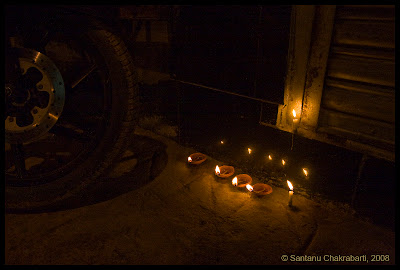
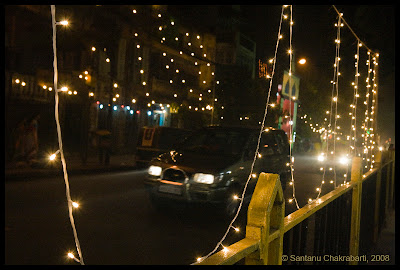
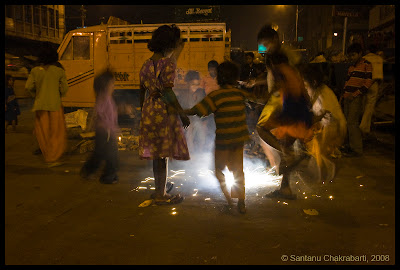
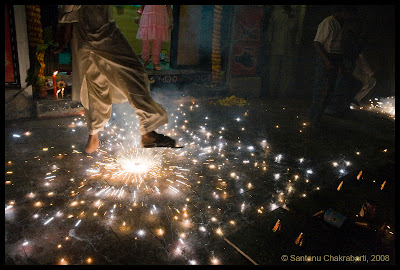
Deepavali - Festival of Light


Diwali or Deepavali is the festival of light celebrated by the Hindus, Jains and Sikhs. It is observed on the new moon day of the month Kartika. Many legends are associated with this festival. Hindus believe that on this day Lord Rama returned to his kindom after defeating demonic Ravana. Jains observe Diwali as the day of enlightenment, when Lord Mahavira attained nirvana. For Sikh's it is the day when Guru Hargobind ji was released from captivity at Gawalior Fort.


People decorate their houses, shops, temples, and their neighbourhoods with lamps and observe a ritual to drive away evil force from their house. Fire crackers are burnt as part of the celebration. In Bengal goddess Kali is worshipped at midnight on this day.
To see more photographs of Diwali please visit my album.

Full story...

Tuesday, September 16, 2008

Chinese Moon Festival in Kolkata


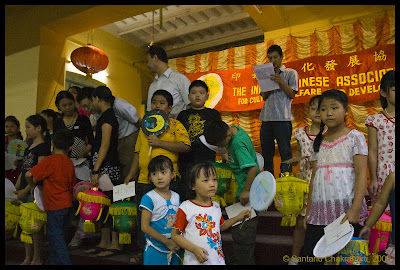
The Moon festival, also known as Mid-autumn festival, falls on the fifteenth (15th) day of the eighth (8th) lunar month of the Chinese calender. Mythological story of the fairy in the moon and a popular story, though historically unsupported, of overthrowing the Mongol rulers from China by the rebels are associated with this festival. On the whole it is a harvest festival when farmers celebrate the end of summer harvesting season and a get-together is organized with the family members and friends. Eating moon cakes and lighting decorated lanterns are some of the customs of this occasion.
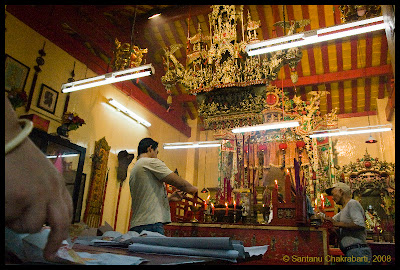
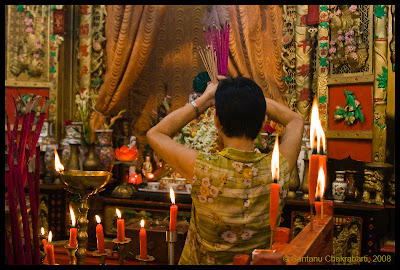
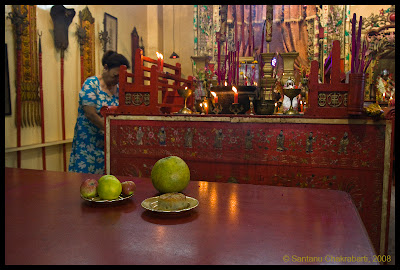
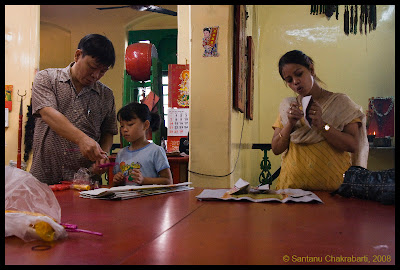
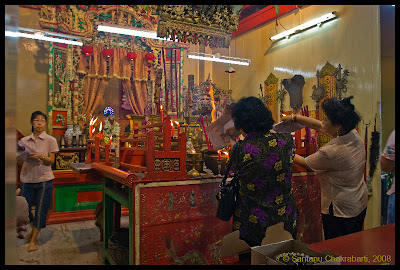
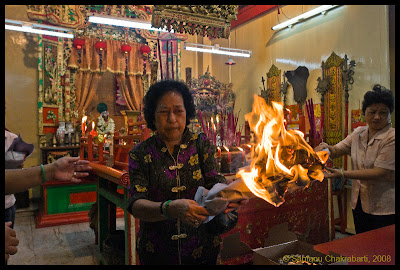
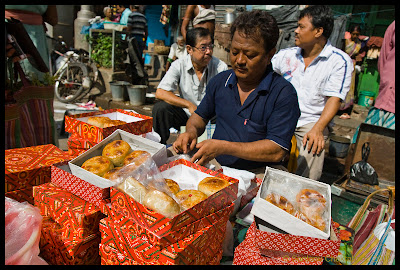
In Kolkata the Indian Chinese community celebrated the festival, this year, on 14th September. A very close knit community of about four thousand members, they started the day with a special worship session at Sea Ip temple. Traditional rituals were observed with utmost sincerity. People offered some citrus fruits and mooncakes to the deities, and prayed for blessings. Some holy papers had been burnt by the devotees as part of the ritual. To satisfy the curiosity of the present writer the person maintaining the temple told that they were not simple papers, they represented money. However he didn't feel interested to explain the ritual to any detail. Mooncakes were sold in huge numbers in the nearby morning market.


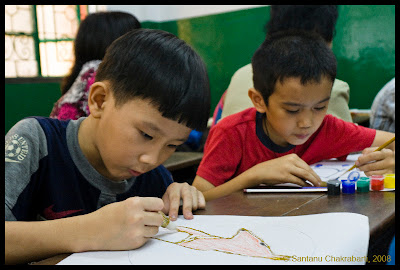
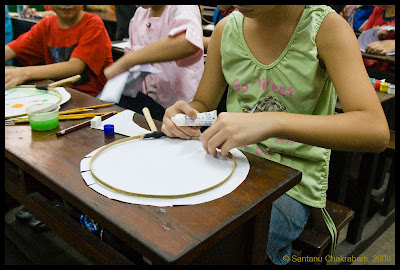
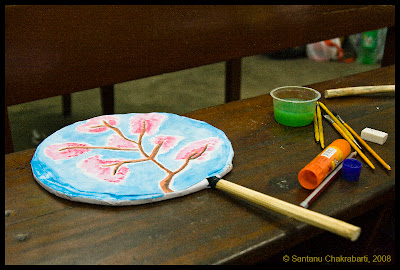
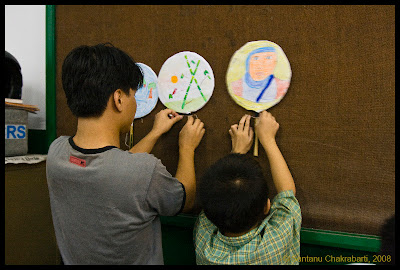
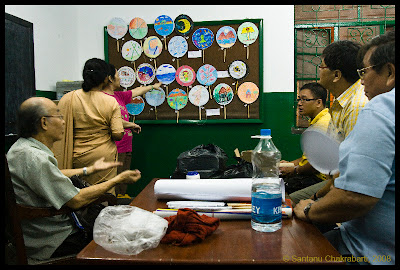
The Indian Chinese Association organized a two days long programme to observe the festival at Sacred Heart School. On the first day, that is 13th September, a Fan Drawing competition was held. The children from the community were encouraged to run wild with their creativity to come up with beautiful decorating pictures for their fans. Frames made of bamboo were provided to them which they pasted with their drawings to turn them into nice hand fans. Seniors in the association chose the winners of the competition who were awarded in the function the next day.

The next day, that is 14th September, was the festival day and a colourful community get-together was organized. The Deputy Consul General Mr. Wen Zhencai was the honourable guest to this event. Children and youngsters from the community took part in the game shows and different musical performances to celebrate the occasion. The event was also a platform to awake curiosity in the mind of the youngsters about the culture of their forefathers and to strengthen community feeling among the Chinese living in Kolkata.PS: To see more photographs of the festival please visit my Picasa album.
Full story...

Sunday, July 6, 2008

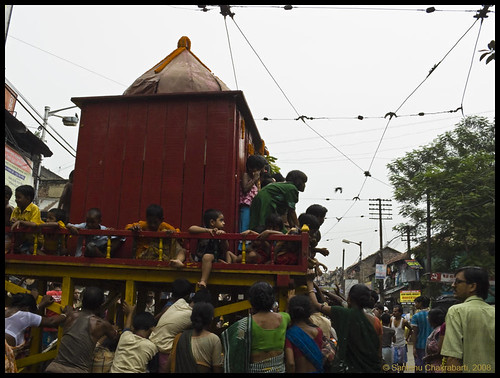
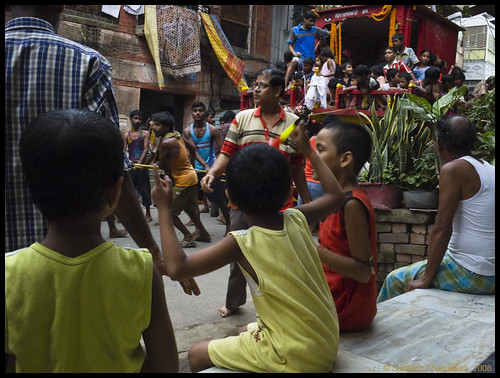
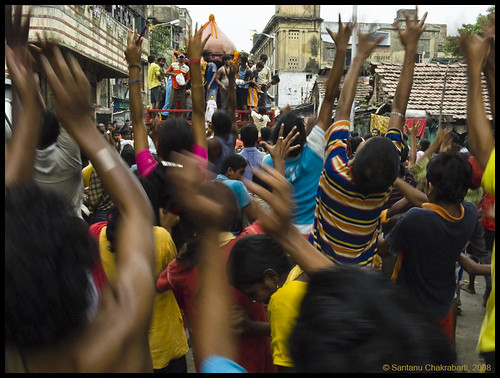
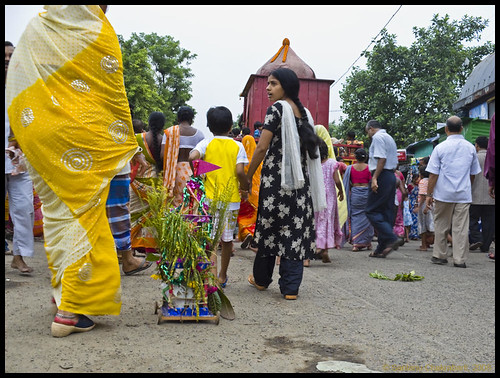
Rathayatra: The chariot festival of India

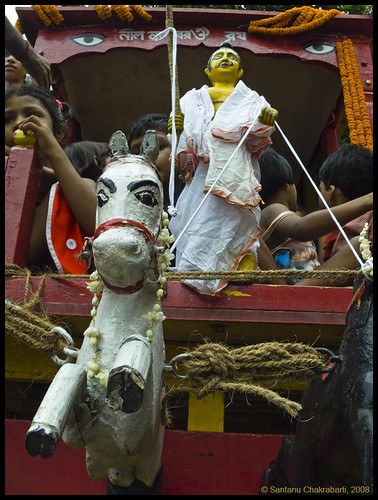
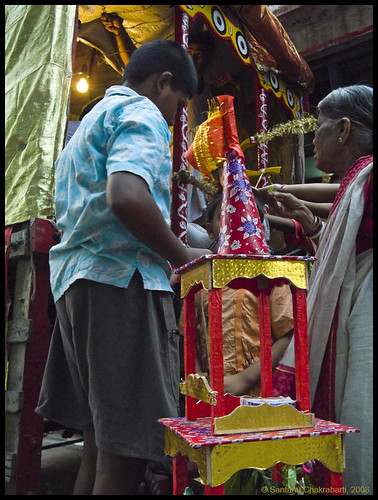
One of the important festivals of Monsoon season in India is Rathayatra, the chariot festival. The last Friday, that is 4th July this year, was the day for the festival. Although the rituals are observed for the seven consecutive days the first day celebration is the most cheerful and pompous one.


The original seat of the festival is at Puri in the state of Orissa though these days, due to Indian diaspora, it seems one can witness the festival in the most unexpected location of the world. In India, other than Puri, there are some places which are renowned for the festival. For example in Bengal the chariot festival in Mahesh is considered to second that of Puri in spirituality.


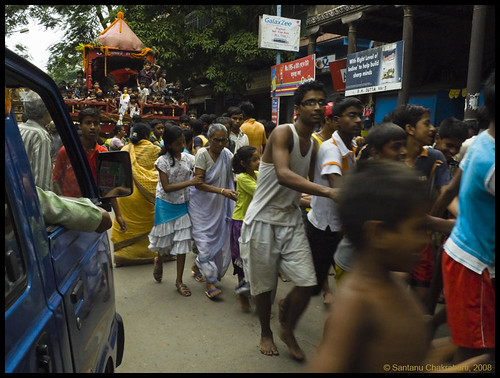
In India to drag the chariot for someone is considered an act of showing the highest honour to the person. When Swami Vivekananda returned after propagating the message of Hinduism at the World Parliament of Religion in USA, the students at Kolkata dragged his horse cart to show their heartfelt respect. The main activity in the festival of Rathayatra is also to drag the chariot of the Gods Sri Jagannatha, Sri Balarama and Devi Subhadra by the devotees. Sri Jagannatha is considered to be the God of all gods and the protector of the whole world. It is believed that on this occasion Sri Jagannatha comes down from his divine abode to meet his devotees on the Earth.


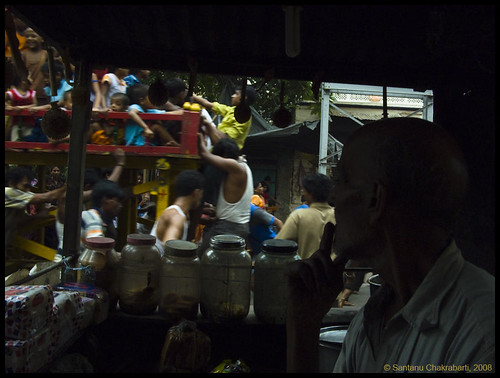
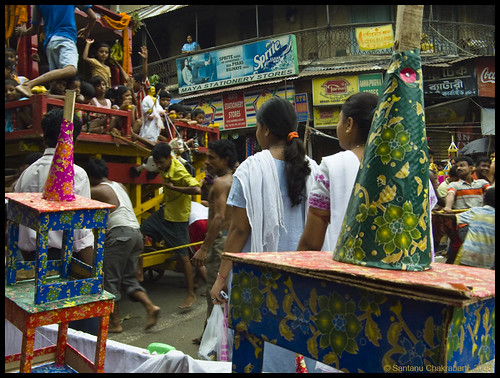
Each neighbourhood in Kolkata has its temple of Sri Jagannatha and the community brings out a chariot which they drag through the streets of the locality. People from the nearby houses come out on the street as the chariot reaches their place to show tribute to the God and to offer sweets and fruits to please Him. Some old families in Kolkata also bring out their family chariots to the street. Recently ISKCON is also celebrating the day in Kolkata and it is one of the most colourful and the biggest events here. However it is the children who seem to enjoy most on this occasion. They buy small wooden chariots from the shops, decorate it with flowers and leaves, place small idols of the gods inside it and then drag it through the streets with blowing of palm leaf horns. At the dusk people get back home buying some bengali snacks like papad, jeelabi, etc.


The God is said to be taken to His aunt's house on the chariot as the part of the first day celebration and after the seven days of observing the rituals on the last day the God is again taken back to His place on the same chariot.


Full story...