Showing posts with label People. Show all posts

Wednesday, June 17, 2009

Gaajan/Charak photos on Photojournale

I haven't been out on the streets with my camera for some days now. Sort of a sabbatical from photography; well if clicking the shutter is all that is about photography. However I worked on my photographs that I took during Bengali New Year celebration and published them on Photojournale:
"Rituals to celebrate Bengali New Year are many. Rural agrarian Bengal used to welcome the new year with the festival of Gaajan/Charak. It is a month long celebration that spans through the last month of Bengali calendar, Chaitra."
More text and photos at Photojournale : Photo journal stories and photo documentary from around the world

I am also putting some efforts recently to roll my new blog with Wordpress: Babbles of a deranged mind. This is in most part a text-only blog and in no way related to my photo-projects. I wish to let loose my ideas and opinions about the world around me through words in this place. I would really like to see you all in my new blog and hope you will find it interesting as much as this one.

Thanks for viewing!!


Full story...

Wednesday, April 29, 2009

Best wishes on World Dance Day

Dance is an integral part of Human existence. Before people learnt to use verbal languages for communication they used systematic movement of body parts as a form of sign language. Even for a successful hunting expedition it was mandatory to perform the ritualistic magic of hunting dance. Today dance is an important component of rehabilitation efforts and therapies organized for the amelioration of emotionally, psychologically or socially challenged people.

To draw the attention of general people towards the contribution of dance to human history and society and to build up awareness about different forms of dances, International Dance Council CID, UNESCO has specified 29th April of every year to celebrate World Dance Day, in the year 1982. All organizations and individuals associated with dance and dancing are requested to organize activities to reach a broader audience than usual.

I have some photographs of dancing from different festivals, ceremonies and rituals that I was fortunate to witness and thought to share them with you on this occasion. So I created the slideshow attached below. I believe the photographs are evidence of pervasiveness of dancing in our society.


Full story...

Thursday, April 9, 2009

Summer is approaching...

This is the last month of Bengali calendar, Chaitra. We are at the threshold of the summer season. Well the truth is we are already into it. Report shows persistent temperature rise in the country, and as a result we are having short lived winter, prolong and tiring summer and untimely rain and storms. Not long back there used to be occasional thunder storm and cyclone during this time bringing relief from heat and humidity; even I have seen it in my childhood days. We call this climatic phenomenon Kaalboishakhi. But from the past few years it has become a rare event. So now we are enduring a long and sticky summer season.

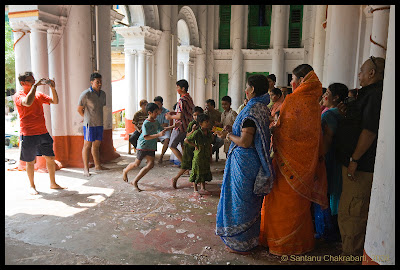
Like changes in climatic condition there are changes in cultural horizon also. Chaitra is the witness to a month long observation of some rituals, that in many cases spills over to the first month of the new year Baishakh. We call it Gaajan and mostly the people from lower rung of the society are the participants. This is a folk religious celebration where an aboriginal god is the central deity whose priest is also a member of the participating community though now a days the festival has been related to the Hindu god Shiva and a Brahmin is seen to take up the role of the priest. Likewise the festival has lost its splendor and ferocity of celebration in Kolkata and its suburbs. The original spirit can now only be found within some interior pockets of rural Bengal.

Social scientists and cultural historians have shown the celebration to be a fertility ritual for an agricultural community where people pray for good rain and fertility of their land in the wake of a dry summer season. It has been shown to be a celebration of marriage between the Sun God and the Earth. The Hindi speaking people from Bihar also worship the Sun God during Chaitra which they call "Chaiti Chhat". The purpose seems to be the same, that is to pray for fertility and good harvest.


Full story...

Wednesday, February 18, 2009

Varanasi: City on the Trident of Shiva

It was well past midnight when I got down from the train, at last, at Varanasi station. The train was eight hours late just to bring us from Allahabad to Varanasi. General compartment of the train was packed with pilgrims and their baggages so no place to sit or move around, just on feet all through. It was a special day for bathing and a huge crowd flocked to Allahabad to take a dip. The boarders were just a fraction of the folk who decided to return home that night.

Where to go at this late hour? All the telephone numbers I had with me just kept ringing with no one to attend them. Luckily the second class waiting room appeared to be a nice place to spend the night sitting there. It had a cafeteria too and I filled up my stomach with a steaming "masala dosa" quickly. I decided to leave the station at 5 O'clock in the morning and expected the darkness to start fading by then.

When it was just a few minutes left for 5 in the morning, I looked through the windows of the rest room and in my eagerness to be at the ghats of Varanasi I took the bright light of the floods outside as the cracking of the dawn. But I was soon put to reality as I was out looking for a rickshaw to take me to Dashashwamedh ghat. And then began the journey which I can't forget for my life. It was pitch-black with thick fog and save the area of the railway station there was no street light. One could not see just a few paces away and I could not make out if I am passing through a jungle or a residential place. Only a few illuminated windows assured me that there were buildings on both sides of the street. The rickshaw-puller was driving quite fast. I could not feel the cold in excitement; did I take a wrong decision? No one could save us if somebody attacked us, no one could even know what had happened before it was pretty late in the morning.

It was only after a twenty or twenty-five minutes ride that I first heard human voices, a group of devotees singing the praise of God Shiva. We passed them shortly after and I was assured that we were heading towards the right direction. After a few more minutes the rickshaw-puller brought me near a tea-shop, "We have reached the ghat, Sir".
"Where is it?"
"Just a few paces away from this place. You see the pilgrims are coming for bathing."

True he was; these pilgrims seemed to be the ones returning home from Allahabad, at least some of them. The tea-shop was also full with customers. I paid the rickshaw-puller and followed the pilgrims towards the Dashashwamedh ghat. During that dark hours the place appeared like a dreamland. There was no light except a neon lamp high above, but the light could not penetrate thick fog. The place was crowded with pilgrims and priests, shadowy human figures. Oil lamps were burning under the umbrellas and sometimes sudden burst of light from hand-held torches. People were moving hastily, may be to ward off cold. I was seated by the steps watching the activities and enjoying the place. The bells in the nearby temples started chiming by then.

I was waiting for the morning light. I had to arrange for a safe place to stay and keep my luggage, then I could come down to the ghat again to shoot in the fog...

And afterward it was all a usual story for a newcomer in Varanasi.

PS: To see more photographs on Varanasi please visit my web-album.


Full story...

Friday, February 6, 2009

Muharram this year and other titbits...

The January was a particularly eventful month. There were lots of events to photograph and there were lots of good and bad in my own life. Well life can never be without events. But some of them I shall like to remember always. I met Michal and Ilona for the first time at Kolkata, and we spent lots of time shooting together, eating, chatting or simply passing away time together. Thank you Michal and Ilona!! I met Anamitra also for the first time on the day I left for Allahabad. And yes I went to Allahabad to shoot at Magh Mela and on my way back home stayed at Varanasi for two days.

This year I actually wanted to visit Sagar island during Sagar Mela. Previously it was planned that I, Jonathan, Michal and Ilona, all four will start for Sagar on 12 January. And I met Jonathan again after an year at Kolkata. But unfortunately the plan couldn't be realized and I couldn't go to Sagar. Later my luck took me to Allahabad instead.

8 January was Muharram this year. It was a grand festival among the Muslims of the city that spans through two days: 7 and 8 January this year. We went through the streets of Kolkata to capture the mood of the celebration. I made the slideshow below with the photographs that I took.

Full story...

Thursday, January 1, 2009

Happy 2009!!


Whistles, screams and crowd; the mood for new year's eve celebration condenses as the clock ticks toward the midnight. Traditionally it is the Park Street/New Market area that pulls most of the crowd in Kolkata. During the British rule it was called "Saaheb paaraa" meaning the neighbourhood of the Britishers and was the epicentre of celebration of the year ending festivals from Christmas. In general psyche the locality is able to maintain its past image even to this age. Although now different sponsored parties, music performances by local bands and other such events are being arranged in different shopping complexes and multiplexes throughout Kolkata, and they also pull huge crowd.

A rock music show was arranged by NIFD students near their campus at New Market to welcome 2009. NIFD is a fashion design school. It was a street-side show and open to all. So the crowd was of mixed nature; from the serious looking elders to the most enthusiastic adolescents, whoever was passing by the place stopped to get a feel of it.

Full story...

Saturday, October 11, 2008

Shuva Vijaya Dashami

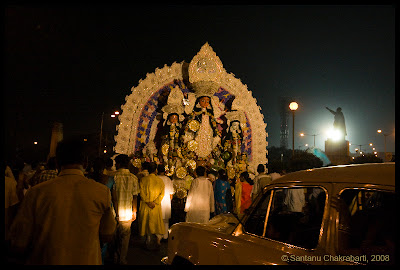
In English the title may be stated as "The blessed tenth day of victory" (though I am not a great translator). This is the day when, it is believed that, Lord Rama got victory over Ravana thus marking the victory of good over evil. Last Thursday was the day for this year.

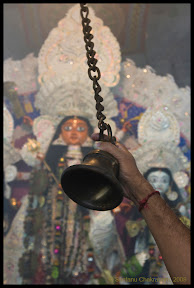
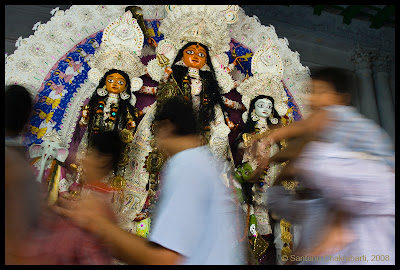
On this day the four days long Durga puja festival in Bengal also comes to its end. Durga puja is the biggest get together event for Bengalees around the globe. Now is the time to bid adieu to our friends and relatives to get back to our work again.

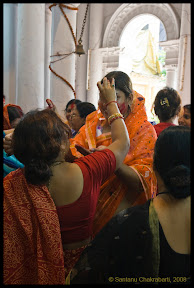
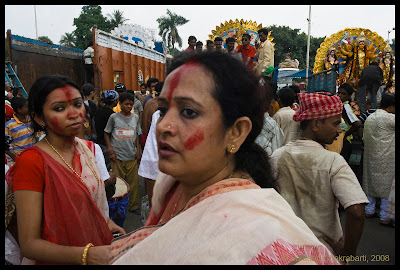
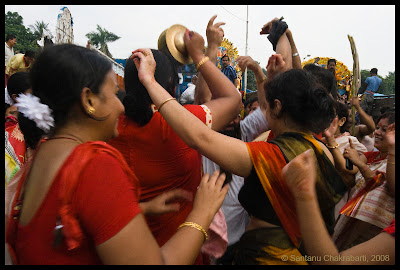
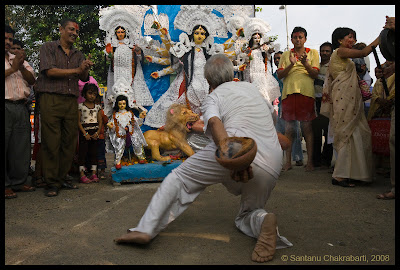
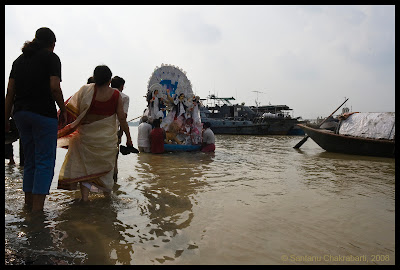
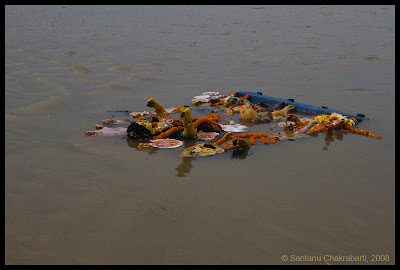
The idol is taken to the river Ganga (or any near by river) for immersion. Some rituals are observed before immersion, like the ritual of vermillion (sindoor/bindi), farewell ritual using a mirror, greeting the idol with sweets before leaving for immersion, etc. On the bank of the river members of the family (girls and boys alike) perform free-style dance before the idol to greet the Goddess before bidding farewell for the year. Huge number of pople flock to the bank of the river to watch the ceremony and the balloon vendors, the candy sellers and other hawking people take this opportunity to make a few bucks on this festive season. But these days they are not alone; big names also arrange ad-campaigns at these sites to spread brand awareness.


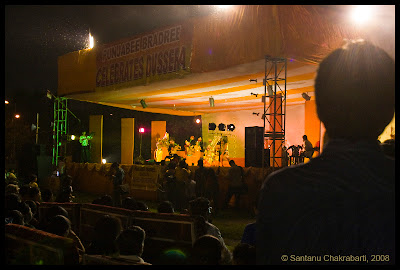
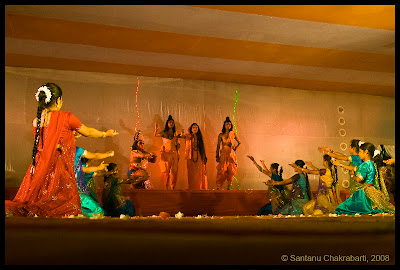
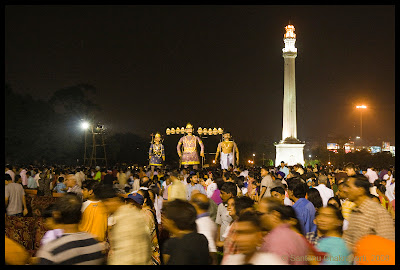
In Kolkata one may also watch enactment of the battle between Lord Rama and Ravana (Ramlila); this year it took place in the ground near "Shahid Minaar". The show was arranged by "Punjabee Bradree" in presence of some ministers of the state and other dignitaries. At the end of the show it is customary to burn effigies of Ravana and his brothers by throwing fire crackers at them. This year, though fire crackers were thrown at them, the effigies could not be set on fire as they had already been soaked in water by city administrators in fear of a possible accident.

To see more photographs please check my Picasa web album.

Full story...

Monday, September 29, 2008

Mahalaya - The first day of "Devi paksha"

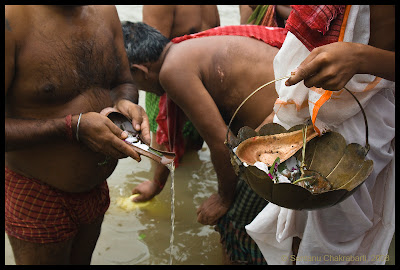
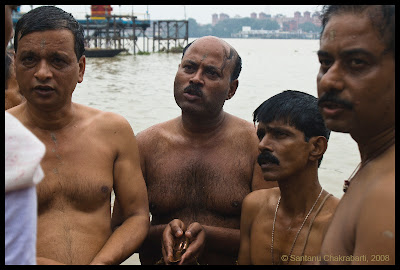
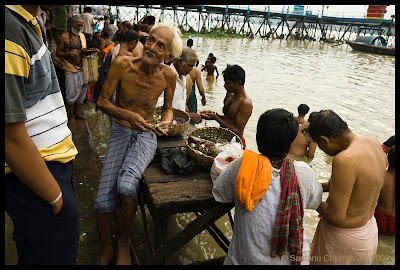
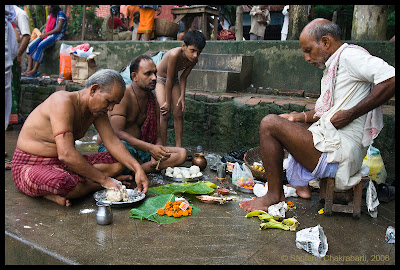
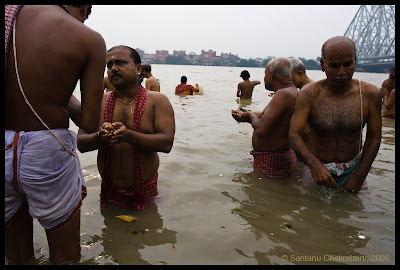
"Mahalaya" is the day from which countdown starts for the biggest festival of autumn season in Bengal. This is the new moon day that marks the end of "Pitri paksha", that is the period of the Gods, and the beginning of "Devi paksha", that is the period of the Goddesses. This is the day to pay homage to our ancestors to seek their blessings before we get into the celebration mood of the festival days.


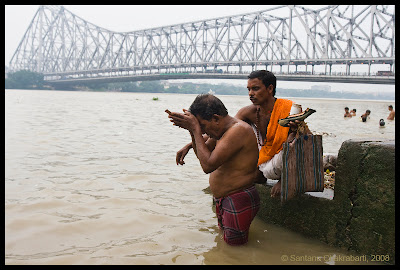
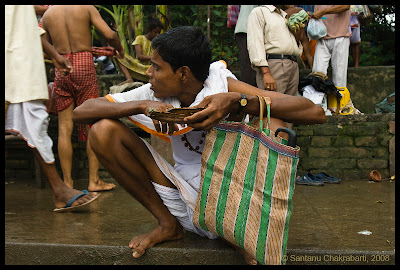
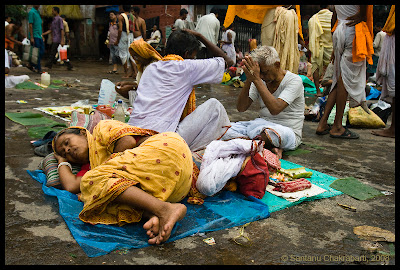
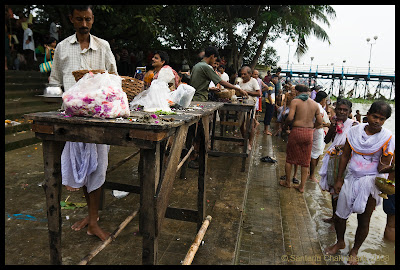
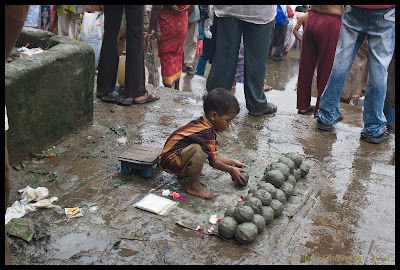
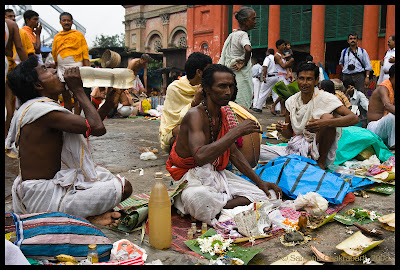
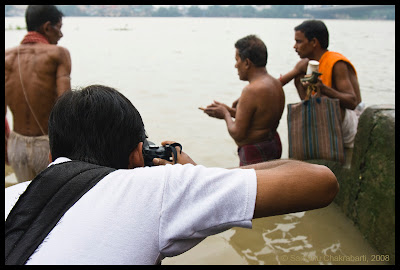
People flock to the nearby banks of the river Ganga to observe the rituals of Mahalaya. Priests come early to execute the ritualistic procedures for themselves and to look for opportunities to earn a few extra money by guiding others who seek to be their "Yajmans" (the customers). Others set up temporary stalls on the bank of the river to sell items related to the ritual.

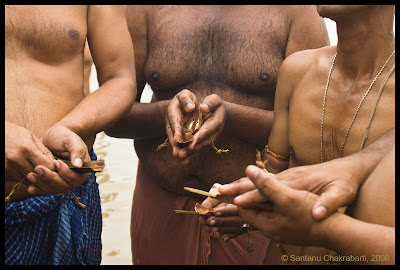
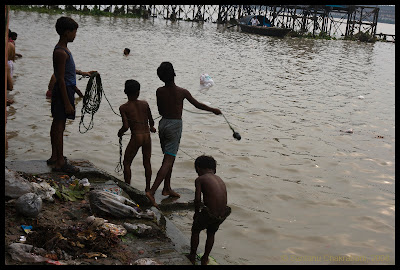
It is the festive season knocking at the door. So everyone is eager for that extra money which they can earn on this occasion. Even the children living in the streets nearby get into their business of fishing out the coins thrown at the river Ganga as offerings. They throw a stack of ring shaped magnets tied with a very long nylon thread into water to pull out the coins for them.The preparation for the four days long festival picks up huge momentum from this day.

To see all the photographs of Mahalaya please visit my Picasa album.

Full story...

Tuesday, September 16, 2008

Chinese Moon Festival in Kolkata


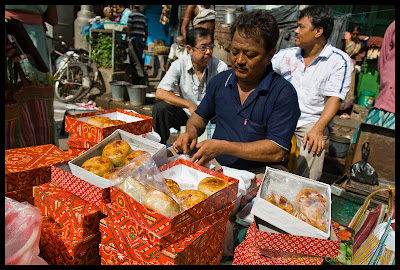
The Moon festival, also known as Mid-autumn festival, falls on the fifteenth (15th) day of the eighth (8th) lunar month of the Chinese calender. Mythological story of the fairy in the moon and a popular story, though historically unsupported, of overthrowing the Mongol rulers from China by the rebels are associated with this festival. On the whole it is a harvest festival when farmers celebrate the end of summer harvesting season and a get-together is organized with the family members and friends. Eating moon cakes and lighting decorated lanterns are some of the customs of this occasion.
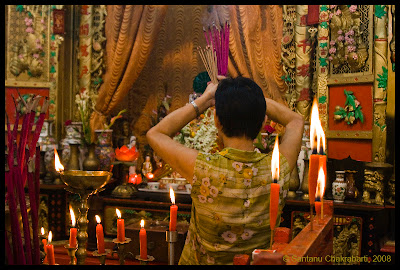
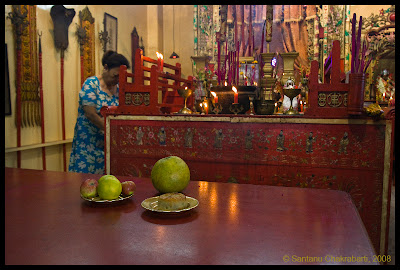
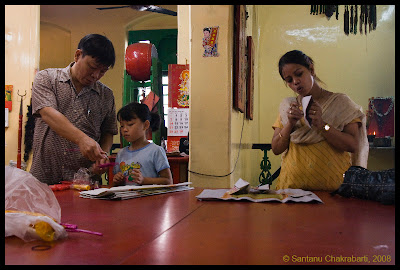
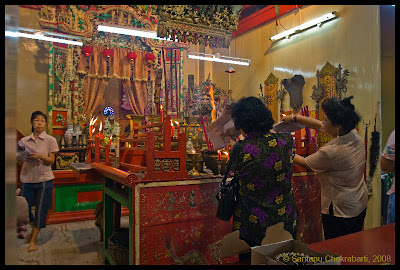
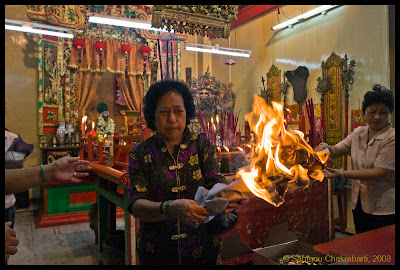
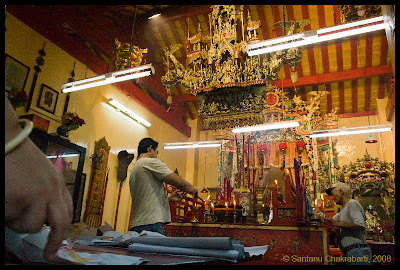
In Kolkata the Indian Chinese community celebrated the festival, this year, on 14th September. A very close knit community of about four thousand members, they started the day with a special worship session at Sea Ip temple. Traditional rituals were observed with utmost sincerity. People offered some citrus fruits and mooncakes to the deities, and prayed for blessings. Some holy papers had been burnt by the devotees as part of the ritual. To satisfy the curiosity of the present writer the person maintaining the temple told that they were not simple papers, they represented money. However he didn't feel interested to explain the ritual to any detail. Mooncakes were sold in huge numbers in the nearby morning market.


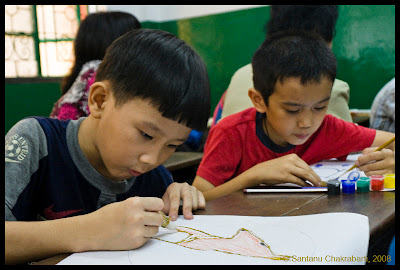
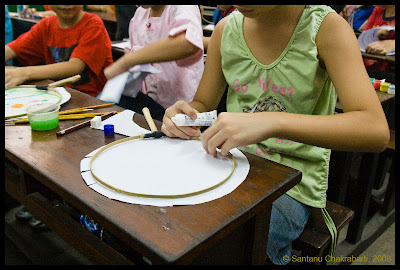
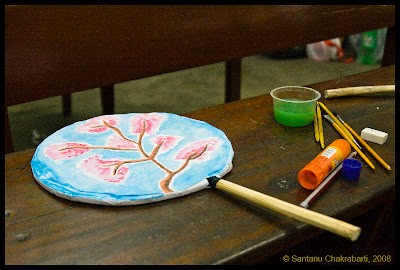
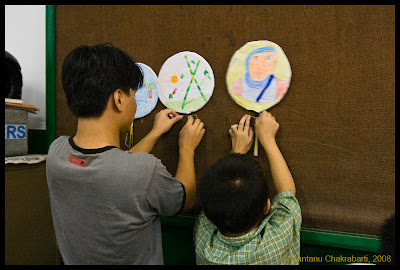
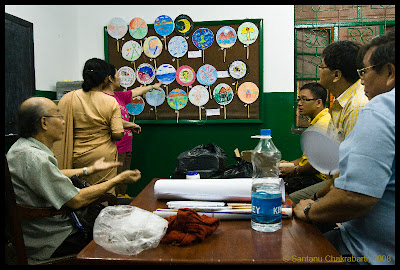
The Indian Chinese Association organized a two days long programme to observe the festival at Sacred Heart School. On the first day, that is 13th September, a Fan Drawing competition was held. The children from the community were encouraged to run wild with their creativity to come up with beautiful decorating pictures for their fans. Frames made of bamboo were provided to them which they pasted with their drawings to turn them into nice hand fans. Seniors in the association chose the winners of the competition who were awarded in the function the next day.

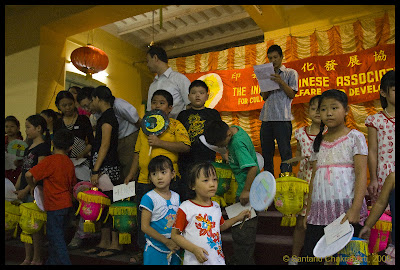
The next day, that is 14th September, was the festival day and a colourful community get-together was organized. The Deputy Consul General Mr. Wen Zhencai was the honourable guest to this event. Children and youngsters from the community took part in the game shows and different musical performances to celebrate the occasion. The event was also a platform to awake curiosity in the mind of the youngsters about the culture of their forefathers and to strengthen community feeling among the Chinese living in Kolkata.PS: To see more photographs of the festival please visit my Picasa album.

Full story...